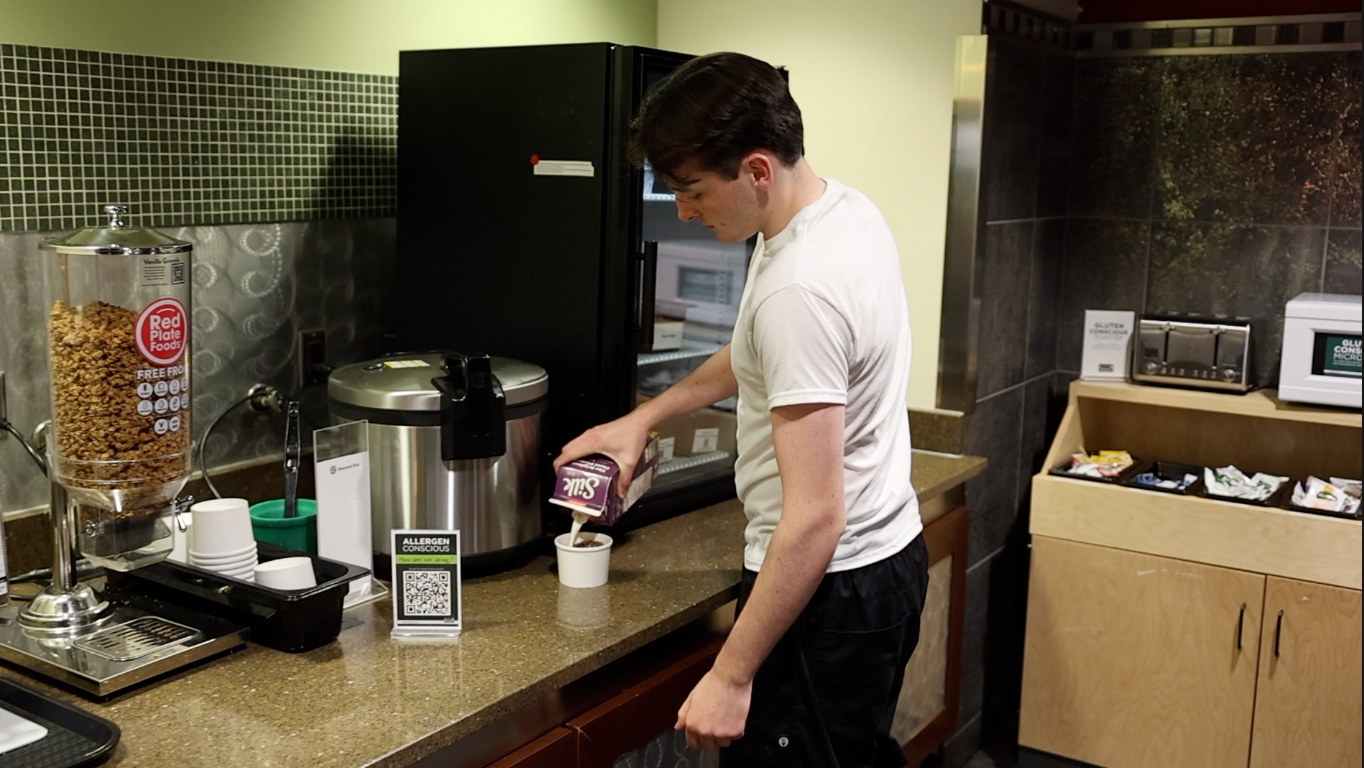
For many students, navigating a dining hall is routine; for others, it can be one of the most stressful parts of starting college. Students managing Celiac disease, severe food allergies or complex dietary restrictions often approach campus dining with caution. Registered dietitians like Kelsey Patterson and Holly Christy work to make sure those students can eat safely and confidently.
Patterson has worked in MSU Culinary Services (CS) for almost seven years and 10 years in college and university foodservice. In addition to serving as a registered dietitian for CS, she’s an adjunct instructor of the Department of Food Science and Human Nutrition and holds a master’s degree in public administration.
Christy received her Bachelor of Science in dietetics from MSU and completed her Master’s in nutrition and dietetics at Western Michigan University (WMU) in 2023. Since then, she’s served as a football nutrition intern at WMU and then as a registered dietitian at MSU for just under two years.
Beyond the Dining Hall
CS begins preparing for the semester before students step on campus. During the summer, Patterson connects with incoming students who report dietary concerns. She offers dining hall tours, answers questions and helps families create a plan before move-in day.
When the fall semester begins, she and Christy meet individually with students and introduce them to chefs and managers. They maintain nutrition and ingredient data in the MSU Nutrition database, review and approve recipes, train full-time staff on allergen awareness and supervise interns who complete projects and host special events each semester.
“No two days are ever the same,” Patterson says. “We might write recipes, review ingredient lists to reduce allergens, host outreach tables or present educational sessions.”
As students' needs grow more complex, so do the demands of the role. CS responded by adding Christy as a second full-time registered dietitian. Looking across the Big Ten, Patterson noted that many peer institutions already employ multiple dietitians in dining operations. The additional position allows MSU to expand outreach, strengthen retail operations and collaborations to move from reactive problem-solving to proactive innovation.
Accommodating Needs
Students continue to report common allergies such as nuts, milk and eggs. At the same time, Patterson has seen growth in conditions beyond the Major Nine allergens (peanuts, milk, eggs, fish, shellfish, tree nuts, wheat, soybeans, sesame). Diagnoses of celiac disease have increased in recent years, aided by improved awareness and screening tools.
As more students arrive with medically documented needs, CS has strengthened its partnership with the Resource Center for Persons with Disabilities (RCPD). Together, they coordinate accommodations that allow students to use their meal plans safely across neighborhoods.
Accessibility and transparency are the main focus. Through the MSUtrition platform, students can review full ingredient lists and nutrition information before selecting a meal.
OrderIT
Three years ago, CS launched the OrderIT app to better serve students with complex or highly individualized dietary restrictions.
Students registered with the RCPD create a profile in the app and tag their specific allergens, including those beyond the Major Nine. The system filters menu options automatically. Students place orders by 6 p.m. the day before pickup, giving staff time to organize ingredients and preparation. One dining hall in each neighborhood offers pickup, including on weekends, for consistent, convenient and safe meals throughout the week.
Dining teams prepare these meals in separate areas using sanitized equipment and strict cross-contact prevention protocols. Staff change gloves, use cleaned tools and seal each meal before service. Through the app, students can message staff directly to clarify preparation details.
“We were seeing more referrals for complex needs,” says Patterson. “Email wasn’t always meeting students where they were. This gives them flexibility and a clear system.”
The growth has been significant. After launching with a few hundred orders in its early years, usage has quadrupled. From August 2024 to January 2026, total orders placed in OrderIT have increased 184%. Many students who use OrderIT rely on it for multiple meals each day. For some, the shift changes their entire dining experience. Patterson recalls working with a student who had rarely eaten outside her home before arriving at MSU. With guidance and practice, the student grew comfortable navigating the dining hall independently, even using a ketchup pump for the first time.
“It’s incredibly rewarding to see that growth,” Patterson says. “Students who start out unsure gain confidence. By the time they graduate, they’re comfortable advocating for themselves.”
Challenging Misconceptions
Some students assume allergen-friendly food lacks flavor or consists primarily of processed substitutes, and others equate it with vegan dining. Patterson challenges both assumptions. Thrive, MSU’s allergen-friendly dining hall, serves meals from chefs who use necessary substitutions and prioritize taste and quality.
To expand awareness, Patterson and Christy launched an Allergy Awareness Ambassador program this semester. Managers across dining neighborhoods will audit their neighborhood and promote best practices, helping grow allergen awareness into everyday culture.
For students with dietary restrictions, food can become isolating. Social gatherings often revolve around meals, and uncertainty about safety can create distance. By prioritizing communication, transparency and innovation CS aims to remove that barrier.
“Communication is key. Asking questions isn’t bad. That’s what we’re here for. We’ll meet students where they’re at — email, virtually, in person — whichever is convenient for them,” says Patterson, “Everyone has to eat, students come here to study and to live a normal college life. Socialization is part of that, and food is part of socialization and having a healthy college experience.”
Inclusive dining, she emphasizes, isn’t an extra service — it’s part of student success.
Learn more at eatatstate.msu.edu/nutrition.
Author: Olivia Williams