In 1980, a graduate student at Michigan State University founded the Committee Commemorating Dr. Martin Luther King Jr. (later to become the MLK Planning Committee), launching what would become a decades-long tradition of honoring the civil rights leader on campus.
That same year, the first commemorative program took place. In honor of Dr. King, a tree was planted and dedicated near the Student Services Building, and a bust, gifted by the Wonders Hall Black Caucus, was mounted in the building’s lobby. What began as a student-led effort to pay homage to Dr. King’s work has since evolved into a broad, university-wide commemoration.
Today, the Office for Inclusive Excellence and Impact coordinates MLK activities at MSU, a role it formally took on in 2000. In 2003, the office successfully endowed a scholarship program in Dr. King’s name, further cementing the university’s commitment to honoring his legacy through action and opportunity.
Each year, the Planning Committee organizes a wide lineup of events for the university and Greater Lansing communities. Everyone is invited and encouraged to participate in what organizers describe as a space for broad exchange of ideas and critical conversations across a spectrum of social justice topics.
The 2026 theme, Justice for All: A Legacy of Courage and Commitment, continues that tradition, offering educational and celebratory opportunities to reflect on Dr. King’s impact, both nationally and within the MSU community.
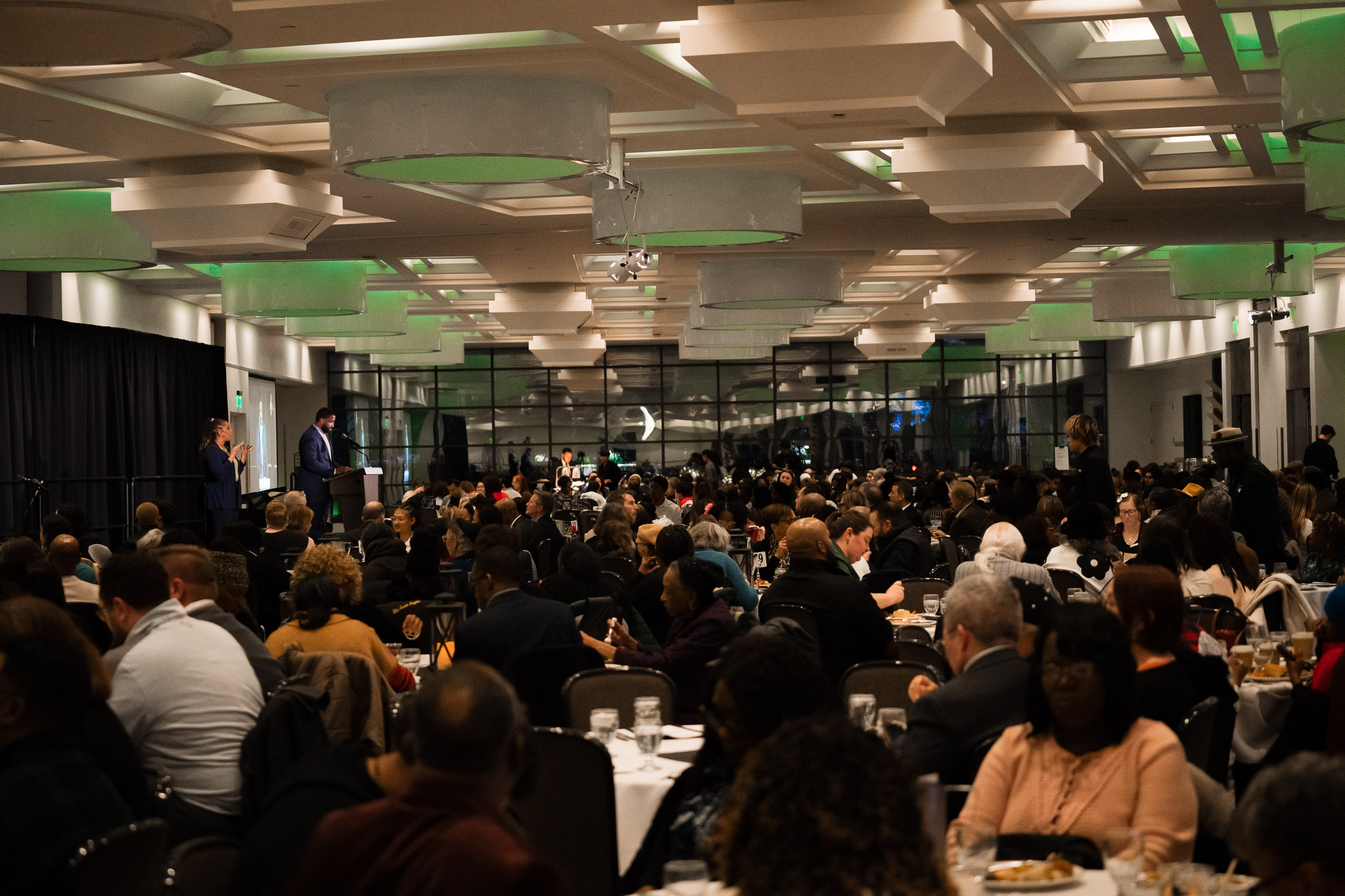
At the heart of the week’s events is one of its oldest and largest traditions: the MLK Community Unity Dinner.
A Dinner That Began with Students
“For my understanding, this started in 1980 from students wanting to have an opportunity to pay homage to the work that Dr. Martin Luther King Jr. has done,” said Dreux Baker, assistant director of community and engagement for REHS, who co-plans the dinner. “Graduate students and staff chose to host a dinner because they wanted an evening event that would allow people to attend after work and classes.”
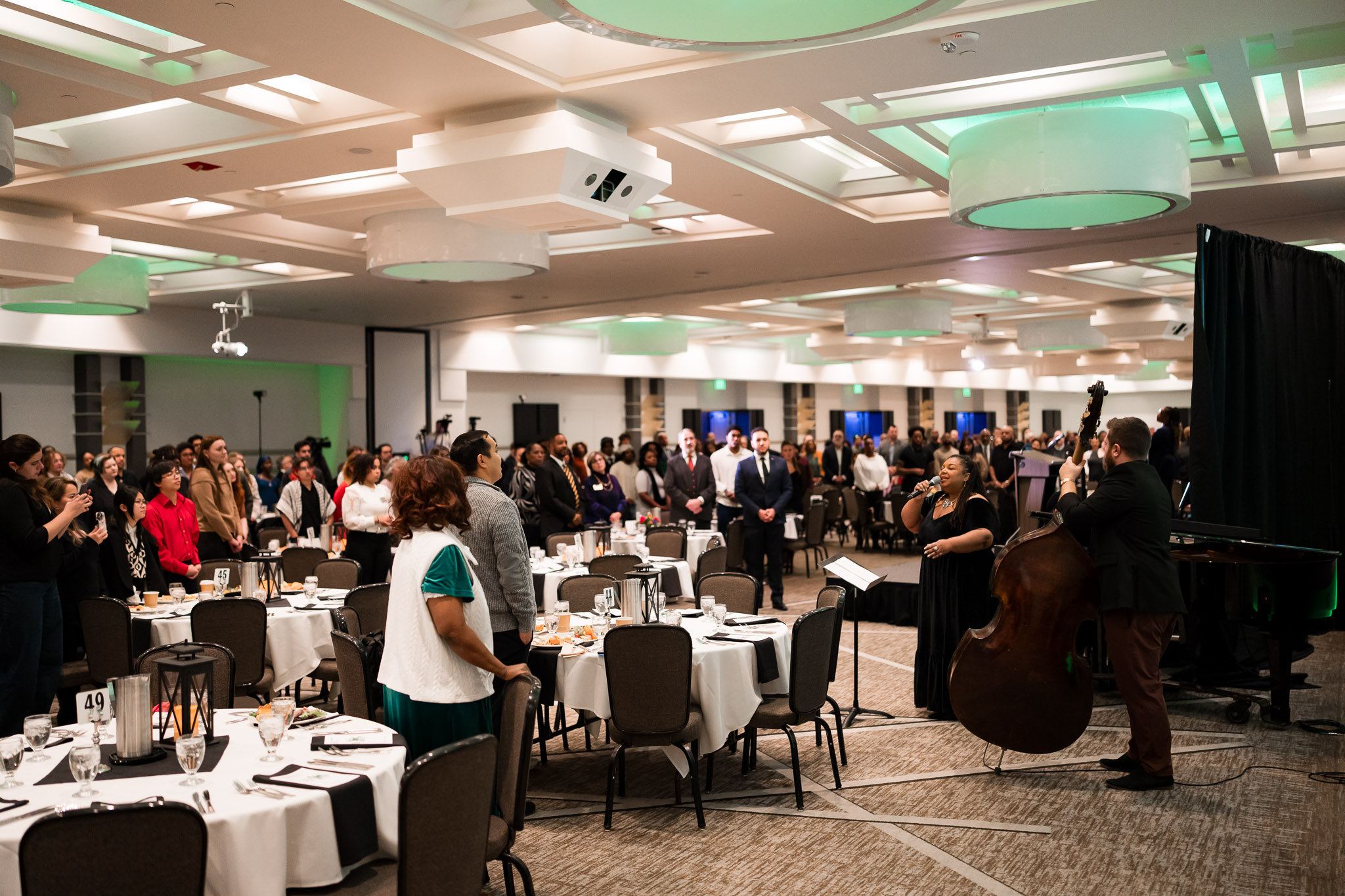
What began as a smaller, more intimate gathering has grown significantly over the past 46 years. Now held at the Kellogg Hotel & Conference Center, the dinner regularly draws more than 400 attendees in a space that can seat over 500 guests.
The event is part of a larger overall celebration planned by the MLK Commemoration Planning Committee, which oversees dozens of events across campus and the Greater Lansing community. While Baker serves on the broader committee, he specifically co-plans the Community Unity Dinner alongside Karen Stowell, who recently retired.
Setting the Tone for the Week
In previous years, the dinner was held on MLK Day itself. Now, it serves as the official kickoff, taking place the Thursday before the holiday. The shift allows it to anchor the week’s programming.
“Because it’s the kickoff, because it’s one of the oldest events — happening for 46 years — and because it’s one of the largest, I think it really sets the tone for the week,” Baker said.
The evening functions as both celebration and catalyst. It is an opportunity to announce upcoming programs, highlight scholarship recipients, and gather faculty, staff, students, administrators and community members in one shared space.
“It’s a really big pillar,” Baker said.
For Baker, the dinner reflects Dr. King’s broader message — one often misunderstood.
“I think Dr. King has been misrepresented in some ways to say that, ‘Oh, he’s only doing this for persons of color,’ but he was about human rights across the board,” Baker said. “He talked a lot about the beloved community. And so, us centering community on that dinner, I think, is important and key.”
Months of Planning, One Impactful Night
Planning the dinner begins months in advance, often as early as September.
Securing the Kellogg Center, coordinating menus, selecting table linens and centerpieces, preparing presentation slides, inviting university leadership and scholarship recipients, coaching student speakers and arranging performers all require careful coordination.
“We contact all of the scholars to see if they’re coming,” Baker said. “We work with the speakers, the entertainment — the actors, the artists, the poets.”
While the logistics are extensive, Baker emphasized that the event’s purpose extends beyond aesthetics or scale.
The dinner’s logistics are extensive, and since the event moved to the Kellogg Center in 2021, the staff have been not only supportive but instrumental in bringing it to life. Rhonda Bucholtz, senior sales manager for the Kellogg Center, serves as the primary point of contact for planning and consistently comes prepared with the most up-to-date information, allowing the team to efficiently navigate the many details involved.
A Space for Intergenerational Community
The dinner intentionally brings together individuals at different life stages and roles, from first-year students to long-serving faculty members to Greater Lansing residents.
“I’m really big on intergenerational interaction,” Baker said. “It’s just not many spaces that I see folks interacting across age.”
In a room filled with diverse experiences and backgrounds, attendees may find themselves seated next to someone they would not typically encounter in daily campus life. That interaction, Baker believes, is part of the work of community-building.
“It’s one of the biggest spaces where community is the center, the reason, the purpose of us being together,” Baker said.
When selecting speakers, he is equally intentional.
“What does Martin Luther King mean to a student from inner-city Detroit who is a first-generation college student?” Baker said. “What does that mean to someone else in a different position on campus?”
By amplifying varied perspectives, the dinner allows attendees to hear voices they may not otherwise encounter, deepening reflection on Dr. King’s legacy.
Being a “Good Villager”
For Baker, the event carries personal meaning. In his remarks this year, he introduced the idea of being a “good villager.”
“Everybody wants a village,” Baker said. “They want that support, they want that help. But it’s hard work. If I’m going to be in this village, I have to be a villager for you just as well as you have to be for me.”
He sees his role as one piece of a much larger effort — small, yet essential.
“I look at it like a tree,” Baker said. “Every leaf has to do its work. Even though you might look at an individual leaf and say, ‘Oh, that’s just a small piece,’ every leaf needs to do that work.”
Providing a meal. Creating a welcoming space. Offering music, performances and thoughtful dialogue.
“It actually means a lot to me to provide community, provide food, provide a space, provide some encouraging words,” he said.
Continuing the Commitment
The 2026 commemoration offered a variety of impactful programs celebrating Dr. King’s life and legacy.
MSU prepared for another year of remembrance and reflection, and the Community Unity Dinner remains what it has been since its earliest days: a space rooted in student initiative, sustained by collective effort and centered on the enduring call to build the beloved community.
Forty-six years after a tree was planted and a bust dedicated in honor of Dr. King, the work continues — not only in speeches or ceremonies, but in the simple, powerful act of gathering at the same table.
Author: Daniela Del Castillo