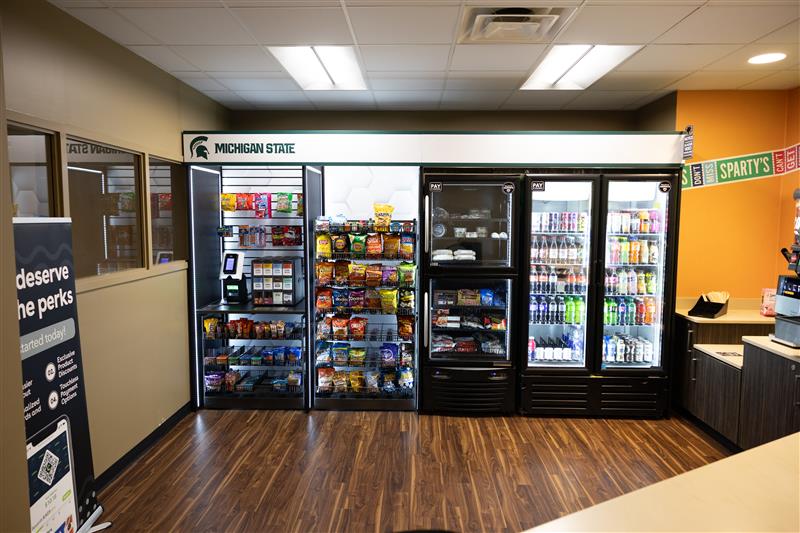
When several Sparty’s locations across Michigan State University closed during COVID-19, faculty, staff and students still working on campus were left fewer convenient food options. As campus returned to a new sort of normal, Culinary Services (CS) saw this need as well as the opportunity to capitalize on new technology in hopes of providing even broader options and a more convenient experience for everyone on campus. Rather than reopening traditional stores, CS explored a different solution — one that balanced accessibility, efficiency and evolving retail trends.
Sparty’s Express locations, self-checkout micro markets, were born!
“These locations really came from a need,” says Gina Keilen, associate director with Retail for Culinary Services. “We had buildings asking for food access, but we didn’t have the staffing or resources to reopen full stores. Micro markets gave us a way to fill that gap.”
Today, Sparty’s Express locations operate in several non-residential buildings across campus, including the Clinical Center, Law College, Administration Building, Engineering Building, and Infrastructure Planning and Facilities (IPF), with another location planned for the Veterinary Diagnostic Laboratory. The markets are primarily for faculty and staff, though some locations — like Engineering and Law — see more student traffic due to their proximity to classrooms, libraries and study spaces.
A Modern Take on Campus Convenience
Unlike traditional convenience stores, micro markets are unstaffed and rely solely on self-checkout technology. Culinary Services partnered with vendor Coley to pilot the concept after researching cashier-less models such as Amazon Go.
“At the time, Amazon Go was more involved than what we wanted to take on,” says Keilen. “Coley had already been a partner with us on campus, and they had recently developed a similar system. It just felt like a natural opportunity to expand that partnership.”
Depending on the location, customers either scan items at a kiosk or simply present a payment card to open a cooler or freezer. Weighted shelves and sensors automatically track what is taken, charging the customer accordingly. Patrons can make purchases using credit or debit cards as well as with Spartan Cash.
“The technology is intuitive,” says Keilen. “People are already used to self-checkout at grocery stores, so it’s been an easy adjustment.”
Filling Food Deserts with Fresh, Local Options
One of the biggest advantages of micro markets is their ability to operate beyond traditional business hours. As long as a building is open, the market is accessible, making it especially valuable for employees with nontraditional schedules.
“For places like the Clinical Center or Admin, people are in those buildings at all hours,” says Keilen. “Being able to offer food options outside of regular hours was really important.”
The markets also allow Culinary Services to offer fresher, more health-conscious options tailored to faculty and staff preferences. In addition to standard snacks and beverages, many locations now feature salads, parfaits, fresh sandwiches, fruits and vegetables.
Recently, Culinary Services expanded offerings by partnering with local favorites Woody’s Oasis and Veg Head, bringing Mediterranean dishes and vegetarian-friendly meals into the micro markets.
“The local piece is huge,” says Keilen. “Faculty and staff really appreciate having something fresh and locally sourced, especially when those options disappeared after Sparty’s locations closed.”
Data-Driven and Hands-Off
From an operational standpoint, Coley largely manages the micro markets. Using telemetric data, the vendor monitors inventory levels and sales trends, allowing team members to restock efficiently and adjust product selections based on demand.
“They can see what’s selling and what’s not before they even arrive,” says Keilen. “It makes it really easy to switch products and make sure we’re meeting the needs of each building.”
Coley handles stocking, inventory and technology maintenance, while IPF assists with cleaning the surrounding spaces. Culinary Services serves primarily as a liaison between building partners and the vendor.
“It’s pretty hands-off for us, which has been great,” says Keilen. “We’re able to provide a service without putting extra strain on our team.”
Strong Reception and Room to Grow
Since launching, Sparty’s Micro Markets have been well received across campus. Annual agreement renewals with building partners have brought positive feedback, and interest continues to grow.
“IPF actually reached out to us wanting one in their breakroom after hearing about it,” says Keilen. “That kind of word-of-mouth shows there’s a real need for this.”
Looking ahead, Culinary Services hopes to continue expanding micro markets into additional campus spaces and exploring new offerings, including the possibility of incorporating merchandise or eventually connecting the system to dining plans.
“This model really fills a void,” says Keilen. “It meets people where they are, aligns with where retail is headed and works well for everyone involved. It feels like a win all around.”
As campus needs continue to evolve, Sparty’s Micro Markets demonstrate how innovation and flexibility can keep the MSU community fueled at any time of day.
Author: Daniela Del Castillo