When campus slows down for the summer, Culinary Services does not stop moving.
While many dining operations close for the summer break or shift to support summer conferences, the season creates something the academic year often cannot: time – time for team members to learn new skills, to strengthen existing ones, to explore new cuisines, and prepare for the thousands of students, faculty, staff and guests who return to campus in the fall.
For Culinary Services, summer is more than a break between semesters. It is a reset.
“We provide training opportunities for our team members so they continue to build their skills, learn new skills,” says Rebecca Selesky, assistant vice president of Culinary Services. “It just is a great time for them to be able to do that because it’s slow enough where they don’t have to be worried about the day-to-day.”
During the academic year, Culinary Services serves more than 40,000 meals a day across campus. With that level of daily service, summer offers a rare opportunity for team members to step away from the rush, take a breath and focus on professional and personal development.
“It gives them a time just to kind of slow down and be able to take that deep breath and work on themselves so that they can be better for the students, faculty and staff in our community,” Selesky says.
Learning by Doing
Summer training includes a wide range of opportunities, from knife skills and equipment training to mental health classes and cuisine-based workshops. The goal is not only to teach technical skills, but to help team members feel more confident, connected and prepared in their roles.
Jason Strotheide, training program coordinator for Culinary Services, says the department has been working to make training more intentional, especially as new team members join.
For a long time, he says, onboarding could feel like a “baptism by fire,” where employees received their uniform, were sent to their work location and learned as they went. Now, Culinary Services has developed a more structured process.
Team members will begin with onboarding basics, such as getting their ID, parking pass and uniform, before moving into several days of skills training. That includes food safety, equipment safety and the fundamentals of working in a kitchen according to MSU standards.
“We’ve tried to be a lot more intentional about bringing people into the space,” Strotheide says.
This intentional approach comes at an important time. Strotheide says Culinary Services has experienced about 50% turnover in its labor force since COVID-19. With more than 500 full-time employees in the department, that means about 250 new faces have joined the team in recent years.
“That’s a lot of institutional knowledge that we need to focus on rebuilding,” Strotheide says.
Building Confidence in the Kitchen
This summer, Culinary Services offered several hands-on training sessions, including breakfast cookery and equipment training, meat, fish and sauces training and basic skills training.
The breakfast cookery and equipment class was created after team members shared how they wanted to learn how to cook breakfast and become more comfortable using kitchen equipment. Designed for dining service workers and culinary platform attendants interested in building toward cook responsibilities, the training uses breakfast service as a practical starting point for developing time management, organization and attention to detail in the kitchen.
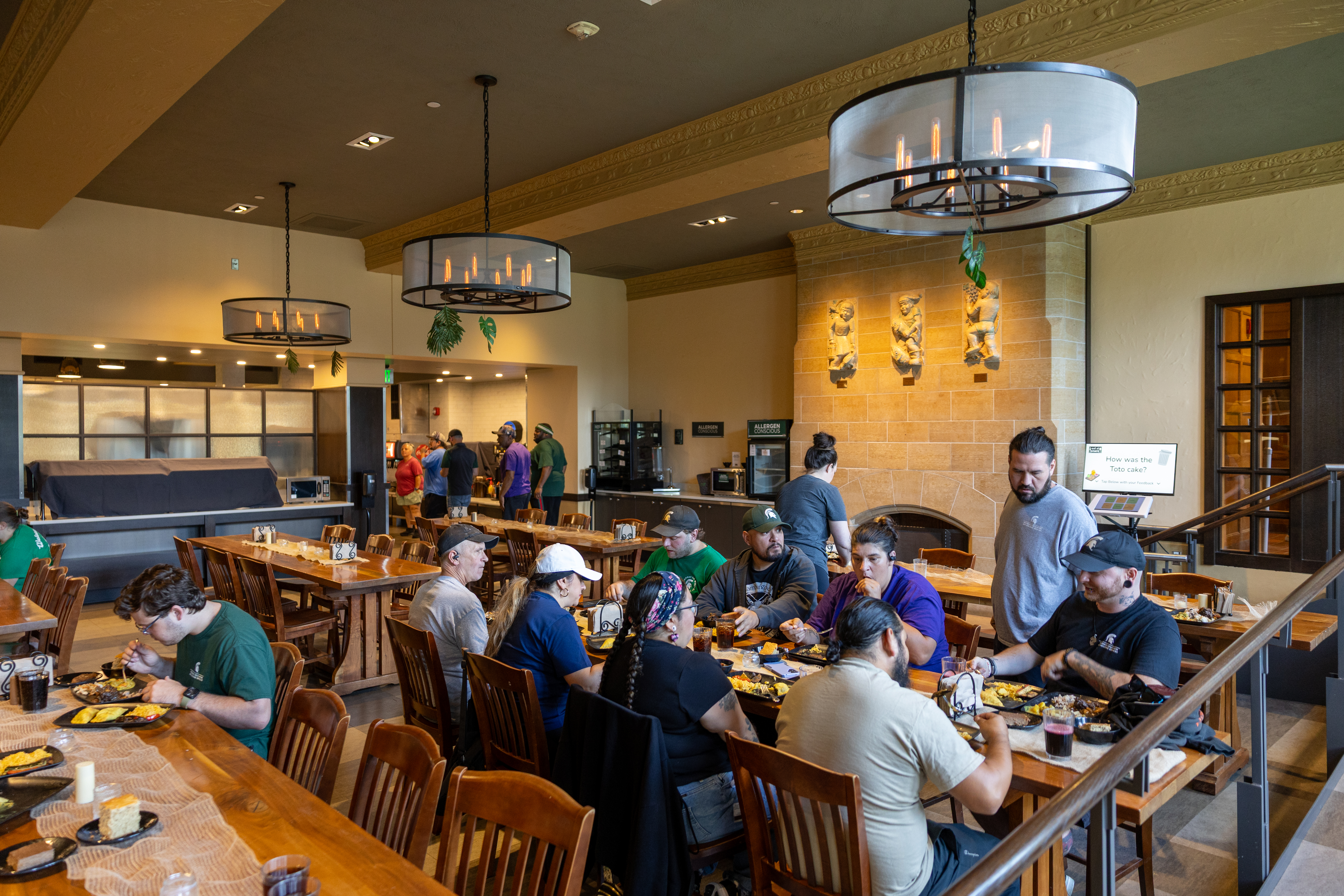
Culinary Services also reformatted one of its basic skills trainings into a three-day session at Brody Square, an active dining hall. Instead of learning in a classroom-style kitchen, participants worked in a real production environment.
The training began with purchasing and stock handling, giving participants a clearer understanding of how food moves through the operation before reaching guests. From there, they moved through cold prep, hot prep, knife skills, equipment training, front-of-house training, beverage service and safety topics, including chemical and bloodborne pathogen training.
Each participant also spent time in every venue within Brody, working alongside the team members who operate those spaces every day.
For Strotheide, one of the most meaningful parts of the training was having participants spend about half a day in the dish room. His first kitchen job, working in a dish room when he was 17, he says, gave him respect for the amount of work that happens there and the people who carry it out.
“I want everybody to understand the amount of work that can fall on the shoulders of those people,” Strotheide says.
The impact of the training became clear when one team member from River Trail Neighborhood shared she had always been curious about taking overtime shifts at Brody Square but felt nervous about not knowing the space. After completing the training, she says she felt more confident.
For Strotheide, that was a win.
Rebuilding Connection
Beyond skill-building, the summer training is also helping rebuild connection across Culinary Services.
Strotheide says when he came to campus in 2008, Culinary Services felt like a close community where people across the department knew one another. Over the past several years, with staffing changes and turnover, some of that familiarity has faded.
Training offers a way to bring it back.
“I felt like what I heard within her statement was that that’s an opportunity for us to build that back again,” Strotheide says. “Getting people to work across channels that they normally wouldn’t, engaging with people that they would normally never have just a chance to meet.”
The trainings bring together team members from different neighborhoods and operations, allowing them to learn from one another and better understand how each part of the department connects.
Selesky says that sense of investment makes a difference.
“They’re just excited, and they feel invested in,” Selesky says. “When you feel invested in and you really feel like you’re working on yourself, I think you just, in return, buy into whatever the product is and you’re willing to put your best foot forward.”
Exploring Food and Culture
Cuisine-based classes are another major part of summer development.
This summer, Culinary Services offered sessions focused on elevated sandwiches, street foods of central Mexico and Jamaican cuisine. The classes allow team members to explore ingredients, techniques, history and cultural context in a way that may not always be possible during the rush of the academic year.
For the Central Mexico session, led by Chef Paulina and Jose from South Neighborhood, Strotheide says the goal was to go beyond familiar menu items and “pull back the curtain” on the food.
“We’re trying to show the history behind the food and some of the stories that go along with these different foods,” Strotheide says.
That includes teaching processes team members may not use every day, such as how tortillas are traditionally made from ground corn. While Culinary Services may purchase tortillas for daily operations because of time and labor needs, Strotheide says understanding the process helps the team better appreciate the food they serve.
For Selesky, cuisine-based training helps Culinary Services bring more authentic dining experiences to students.
“When we bring different cuisines into the dining halls, we want to try to make them as authentic as we can,” Selesky says. “We give them this opportunity to really be able to develop and really hone those skills.”
Preparing for Fall
Behind every meal served during the academic year is a long period of preparation.
Selesky says many people may not realize how much work happens before students return to campus, from training and procurement to preparing dining halls and supporting campus facilities. When dining halls close for the summer, some Culinary Services team members also assist facilities partners by helping clean and prepare buildings for the fall.
“There’s a lot of preparation,” Selesky says. “Although kudos to the culinary team – they make it look easy. It always seems pretty seamless in the beginning, but there’s a lot of work that goes into the behind the scenes.”
That preparation is becoming more consistent. Strotheide says Culinary Services is moving toward a year-round training model, with training expected to take place during the first and third weeks of every month.
The long-term goal is to create a foundation that can support the department for years to come. Strotheide, who stepped into the training program coordinator role after years of advocating for more structured culinary training, says he hopes to build something strong enough to continue beyond his time in the position.
“This would be a great way to build something out for the next generation of this department,” Strotheide says.
For him, some parts of Culinary Services will always evolve. Menus change. Trends change. Needs change. But the foundation remains the same.
“Food safety is one of those things you can never have enough of,” Strotheide says. “You can’t have quality without safety, and you can’t have safety without quality.”
At its core, the summer training is about serving people better by supporting the people who serve them.
Selesky says investing in the team is one of the most important parts of her role.
“The team is really, really important to me, and they’re really incredible,” Selesky says. “To be able to do this for them, for everything that they do for us is awesome. I think it’s a win-win on both parts.”
And when fall arrives, that work shows up in every dining hall, every interaction and every meal.
“We care about our community,” Strotheide says. “We’re trying to do more to do better.”
By: Daniela Del Castillo