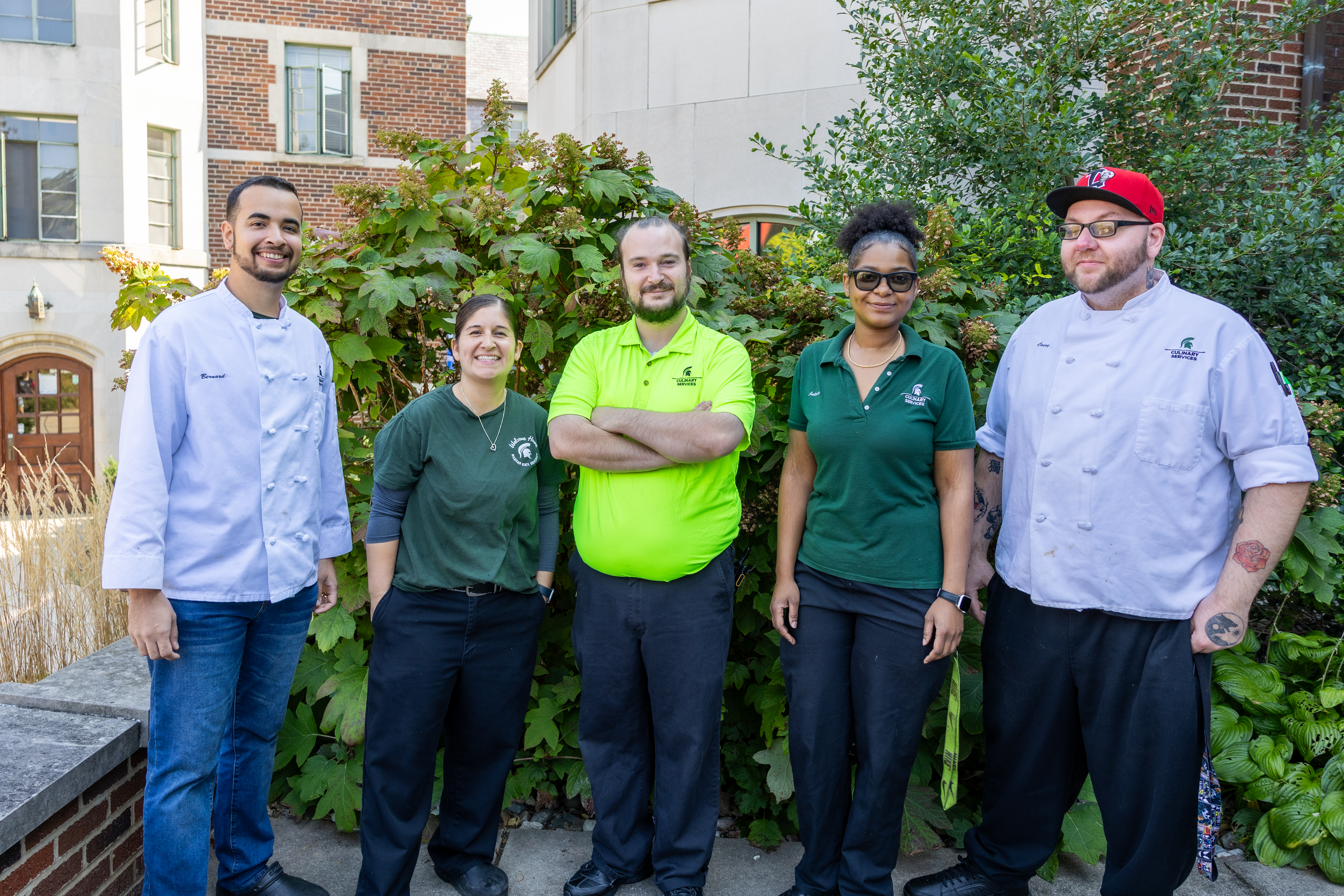
Michigan State University (MSU) has been recognized by the Association for the Advancement of Sustainability in Higher Education (AASHE) as a Outstanding Case Study recipient for its Culinary Services (CS) Eco Ambassador program. This staff-driven initiative focuses on implementing hands-on sustainable practices across the university’s dining locations.
The Eco Ambassador program includes 51 CS staff members representing each campus neighborhood — Brody, North, East, South and River Trail — as well as Kellogg Hotel & Conference Center and Support Services, including MSU Bakers, Food Stores and Spartan Linen Services. In this role, staff members are empowered to promote sustainability from within their respective units by identifying opportunities for improvement, such as enhancing waste collection processes, updating signage and leading team members towards best practices.
“The eco ambassadors are honored to receive recognition from AASHE,” states Carla Iansiti, MSU Residential and Hospitality Services (RHS) sustainability officer. “As a collaborative staff-led organization, the Eco Ambassador program sets a precedent for other institutions by translating the university’s broader commitment to sustainability into practical, day-to-day actions.”
Gregory Petrone, assistant dining services manager and eco ambassador who has helped shape the program, emphasized the measurable impact the initiative has had across campus dining operations.
“Over the past two years the eco ambassadors have continued to impress me,” Petrone says. “They have each demonstrated their passion for sustainability in multiple ways. Compared to our baseline food waste year in 2024–25, we have reduced our post-consumer food waste by 29,100 pounds in the 2025–26 school year across all CS locations. This prevented approximately 20,000 pounds of carbon from entering our atmosphere — I’m proud of that.”
Petrone also reflected on the national recognition from AASHE and what it represents for the university and its staff members.
“As a relatively unique program within higher education, I am ecstatic to see that the time, effort, training and outreach our members have participated in over the previous two years has led to MSU being a beacon of sustainability among other universities,” Petrone says. “While I have helped shape this program, I feel that I am just advocating for our staff in our working units who make the real impact to our larger MSU community.”
As eco ambassadors, CS staff have a direct means to advocate for sustainable practices within their units. Rachel Schineman, executive sous chef at Brody Square dining hall, described how her role has transformed her approach to work.
“Serving as an eco ambassador has enabled me to support sustainability in our dining locations in North and Brody neighborhoods,” Schineman said. “I enjoy collaborating with our team and assisting them in recognizing the significant impact their efforts have on enhancing the sustainability of MSU.”
The eco ambassadors have also played a pivotal role in piloting Raccoon Eyes, an AI-based tool for tracking post-consumer food waste used in two campus dining halls.
“In its first year of installation, Raccoon Eyes analyzed over one million plates and identified approximately 57,539 pounds of wasted food,” Iansiti shares. “We aspire to further reduce food waste in the coming years through continued staff participation and student engagement.”
Petrone noted that the success of the program has been driven by the staff members themselves and their desire to make sustainability part of daily operations.
“We saw outreach and a desire for a program like this from CS staff members across the university,” explains Petrone, “and we were fortunate to have the opportunity to build this collection of team members who really drive the content and opportunities the eco ambassadors receive.”
Leadership within CS emphasizes that the ambassadors’ firsthand experience enhances the program's effectiveness.
Rebecca Selesky, assistant vice president for CS, says it’s a matter of values. “Incorporating sustainability into our daily culture and operations uplifts shared organizational value. The presence of eco ambassadors advocating for sustainability throughout campus dining ensures long-term consistency and accountability.”
Selesky elaborates on how the national recognition from AASHE highlights the significance of team-member-led innovation. “Awards such as this validate the efforts within CS and position MSU as a model for other universities. This recognition creates momentum for continued investment in innovative technologies, employee development and sustainable dining solutions.”
Petrone adds, the recognition reflects MSU’s broader commitment to sustainability and staff engagement.
“Our staff’s desire for this program exemplifies MSU’s strategic plan for staff and faculty success, sustainable health and stewardship for a sustainable future. By training, developing and including staff in sustainability decision-making that directly involves their work unit, we are directly impacting staff success, making for a better campus and better world.”
To learn more about the Eco Ambassador program and the sustainability initiatives of Culinary Services, please visit the Eat at State website.
Author: Bethany Zimmerman