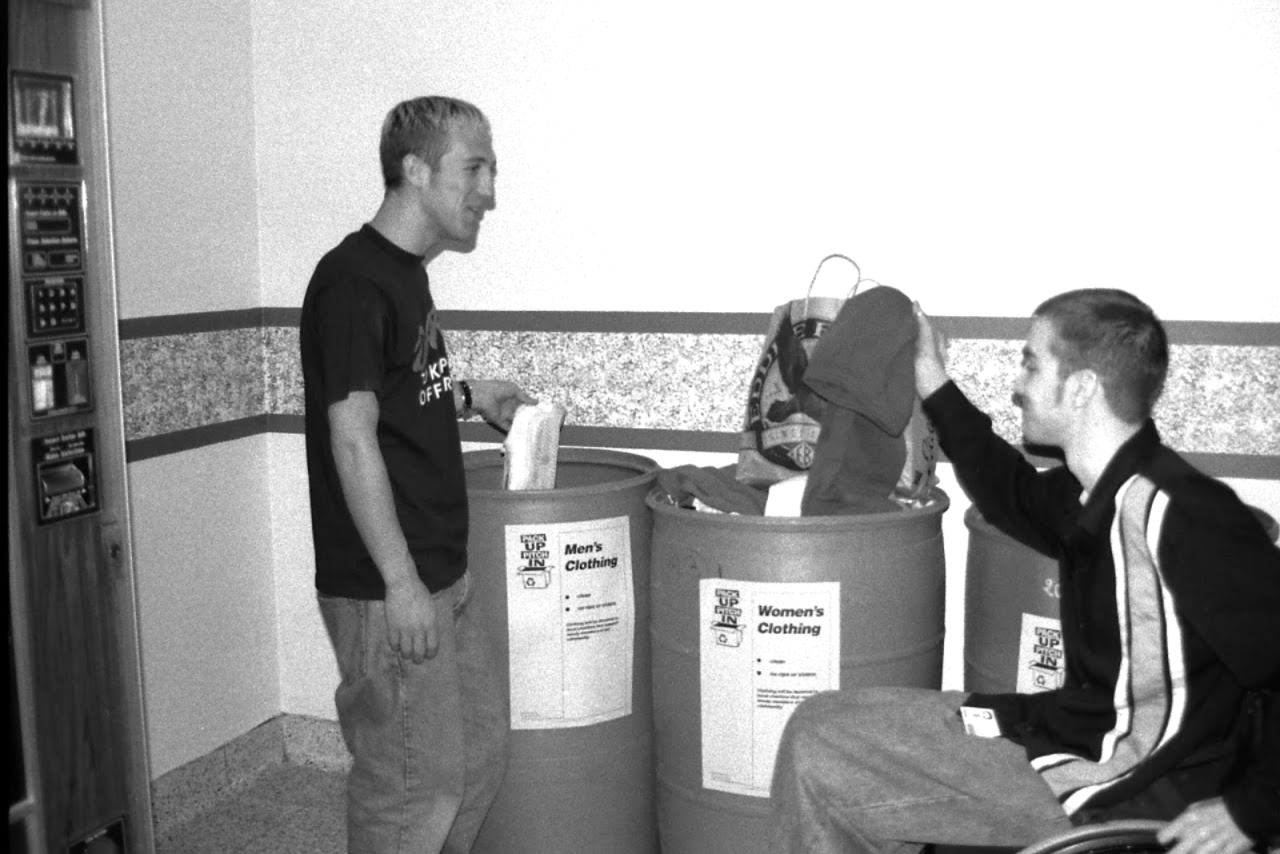
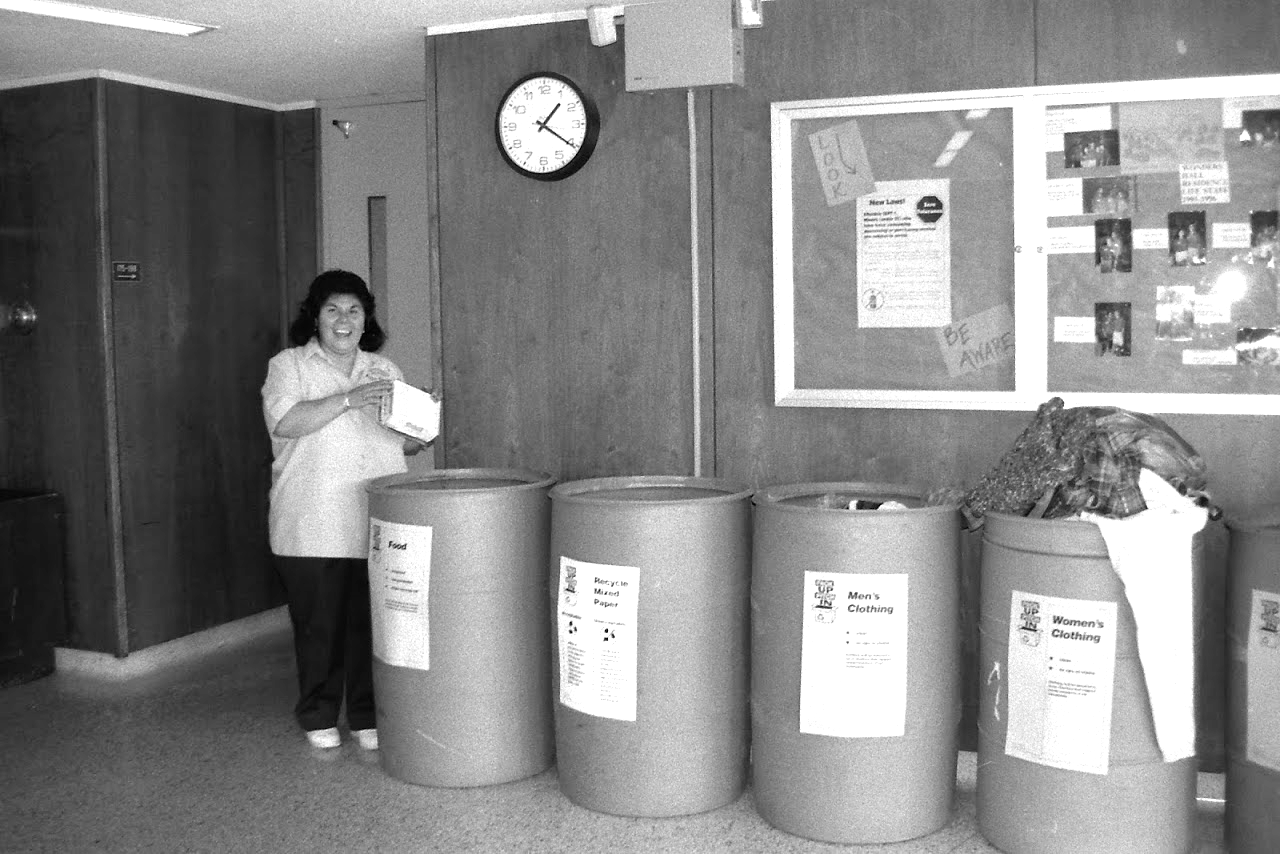
For 30 years, Pack Up. Pitch In. has helped Michigan State University students close out the academic year with sustainability in mind.
What began as an effort to reduce the amount of waste sent to landfills during move-out has grown into a campuswide program that supports reuse, recycling, donation and community care. Each spring, as students pack up their rooms, Pack Up. Pitch In. helps collect usable items that might otherwise be thrown away, giving them a second life through the MSU Surplus Store and Recycling Center (SSRC), the MSU Student Food Bank and local community partners.
For Residential and Hospitality Services Sustainability Officer Carla Iansiti the purpose of the program is simple.
“It was created to help keep things out of the landfill,” she says.
But behind that simple goal is a large operation built on decades of student action, campus collaboration and a shared commitment to reducing waste.
A Student-Led Start
The roots of recycling at MSU go back more than 30 years. In 1988, 11,600 students petitioned the MSU Board of Trustees to focus on recycling, leading to the creation of a task force to develop a waste reduction plan.
By 1990, recycling services were established on campus to collect office paper, cardboard and newspaper. Throughout the decade, recycling volumes continued to grow, requiring additional trucks, building space and collection areas, including a drop-off center at University Apartments.
By the end of the 1990s, MSU was sending 5 million pounds fewer to the landfill each year.
As recycling efforts expanded into the early 2000s, MSU began collecting nontraditional materials such as electronics, toner and pallets. In 2008, recycling and waste services combined with the Surplus Store to form the MSU SSRC. Construction then began on a new facility to house SSRC operations.
The 74,000-square-foot facility was completed in 2009, with a public drop-off recycling center open 24/7. In its first year, the facility became LEED Gold certified, collected 3.6 million pounds of recycling and sold $3 million in surplus goods.
Since then, MSU’s sustainability work has continued to grow, from food scrap collection and composting to vermicomposting and the addition of sorting technology through an EGLE grant.
Pack Up. Pitch In. is part of that larger story.
What Move-Out Looks Like Behind the Scenes
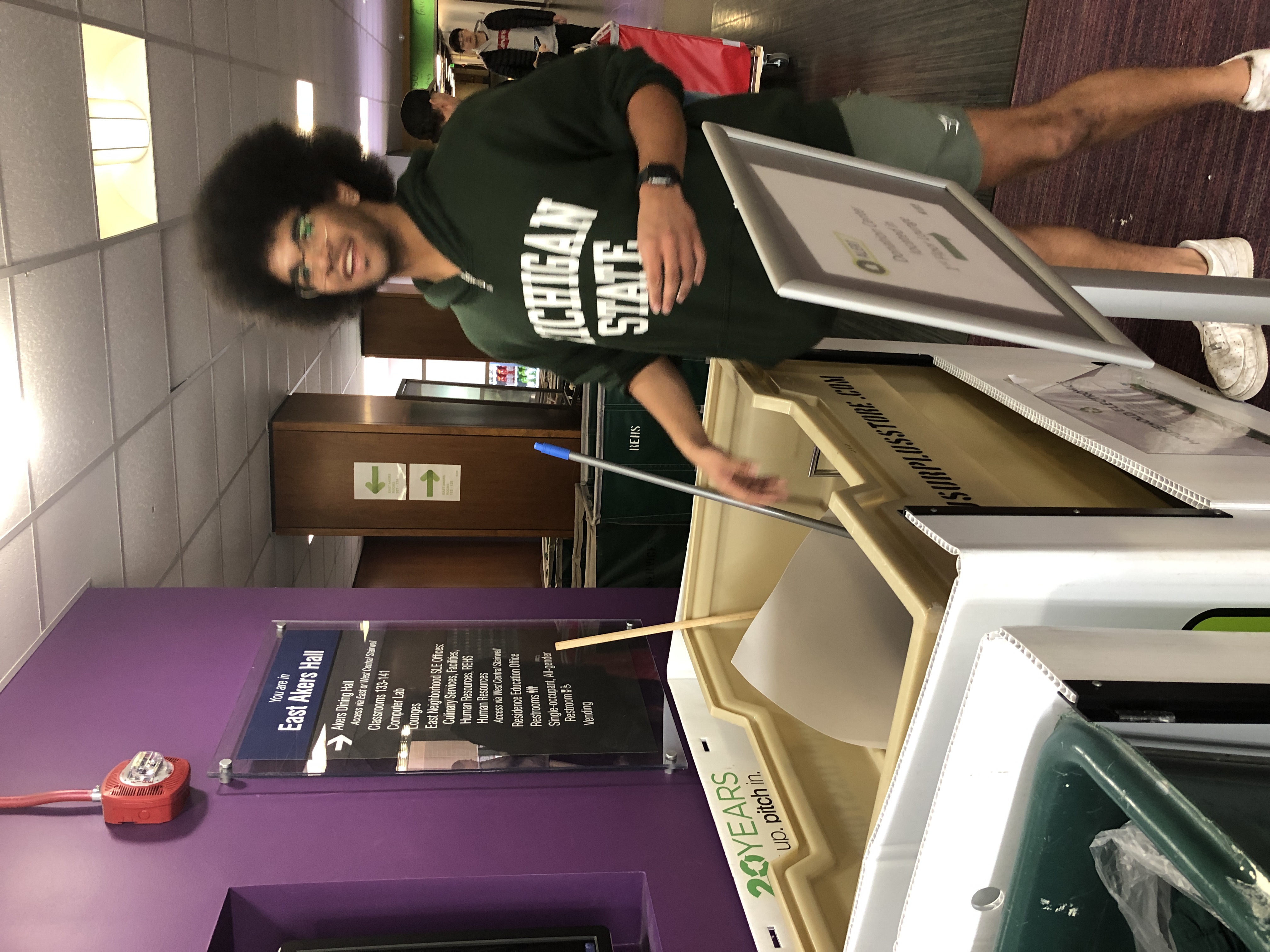
During move-out, students are encouraged to donate usable items instead of throwing them away. Those items can include mirrors, laundry baskets, shower caddies, lamps, futons, room goods, nonperishable food and personal care products.
While the process may look simple from the outside, Iansiti says there is a lot of work involved in making it happen.
“It’s a lot of labor,” Iansiti says. “It’s a lot of planning and coordination to get students to take what they don't want anymore to various drop zones in their res hall.”
Because each residence hall is designed differently, staff members must determine where donations can be safely collected and stored until they are transported. Some items may be stored in basements, separate rooms or other designated spaces before they are picked up and sent to MSU Surplus.
The program also helps improve safety during move-out. Without a collection system in place, large items can end up in dumpsters, creating hazards and making waste collection more difficult.
“Sometimes it feels like students are trying to play Jenga with a futon and see if it fits into a dumpster,” Iansiti says.
By collecting items through Pack Up. Pitch In., staff can better manage move-out waste, reduce landfill costs and keep residence hall spaces safer.
Impact by the Numbers
This spring, Pack Up. Pitch In. had a 32.3% diversion rate. More than 106,832 pounds of student room items were recovered during move-out, including mirrors, lamps and other room goods.
The program also collected 10,172 pounds of recycling, including paper, plastic, organics and cardboard. While 445,580 pounds of trash were still collected, the diversion rate reflects the continued effort to keep usable and recyclable materials out of landfills.
While Pack Up. Pitch In. has become a consistent part of move-out, Iansiti says there is still more work to do to help students understand the impact of their choices before, during and after their time living on campus.
Finding a Second Life
One of the main goals of Pack Up. Pitch In. is to find new homes for items students no longer need.
Through the MSU Surplus Store and Recycling Center, usable items can be resold or redistributed instead of being thrown away. Furniture, residence hall items, bikes and other materials can be repaired, reused or made available to the public.
Iansiti says the Surplus Store plays an important role in helping the university avoid unnecessary waste in that it “helps us find a home.”
That same idea applies to food and personal care donations. During move-out, collection posts are set up at Service Centers, making it easier for students to donate items as they leave campus.
Nonperishable food donations are collected and redistributed through the MSU community, the MSU Student Food Bank and local food banks. Gently used personal care items, laundry detergent and cleaning supplies can also be collected.
“It’s just finding a new home for items,” Iansiti says.
More than Recycling
Over time, MSU’s sustainability efforts have expanded beyond traditional recycling.
Food scraps from campus kitchens are collected and sent to be composted or processed through vermicomposting. Preconsumer food waste, such as produce scraps, can be used by the worm farm at the SSRC to create compost. Other food waste is sent to a local composter and later used to support campus landscaping.
The work connects many parts of campus, including RHS Sustainability, Culinary Services, Residence Education and Housing Services Facilities teams and the SSRC.
Iansiti says collaboration is easier when everyone is focused on the same goal.
“When everybody has the same goal, the end result is just keep it out of the landfill,” Iansiti says. “It’s really not that difficult.”
In addition to move-out collections, MSU also offers opportunities for students to engage with sustainability throughout the year. The SSRC hosts events focused on thrifting, upcycling and reuse, giving students low-cost ways to participate in sustainable practices while learning new skills.
Looking Toward the Future
As Pack Up. Pitch In. celebrates 30 years, Iansiti hopes the program continues to grow in visibility and impact.
She says she would like MSU to be known not only for move-in and move-out efficiency, but also for the care behind those processes.
“MSU is known for its fabulous move-in and move-out program because we care,” Iansiti says. “We don’t want to throw things away needlessly. I'd love for it to be known that MSU is a green campus, and this is one way to show it.”
For Iansiti, the future of Pack Up. Pitch In. is also about helping students think sustainably before they even arrive on campus. That means encouraging students to talk with roommates before buying duplicate items, considering used or secondhand options, using campus transportation resources or thinking about what they will do with their belongings when they move out.
The culture around campus waste continues to change, especially with increases in takeout orders, single-use packaging and individually packaged items. Still, Iansiti says the program will continue to adapt.
“One step at a time,” she says.
After 30 years, Pack Up. Pitch In. remains a reminder that sustainability at MSU is built through everyday choices, behind-the-scenes labor and a campus community willing to give items a second life.
Author: Daniela Del Castillo