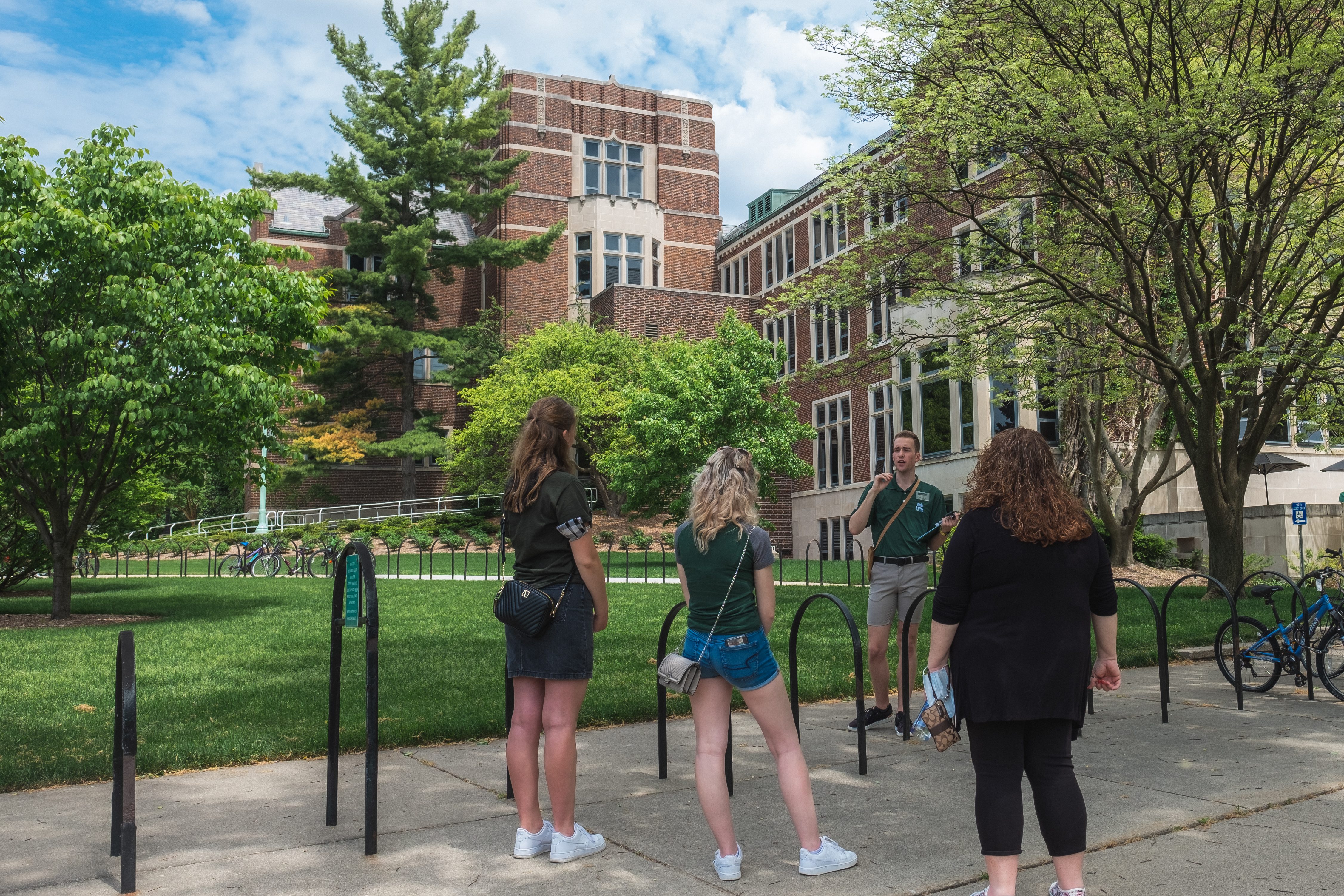
Becoming an MSU tour guide takes more than enthusiasm — it requires a six-week course, tour shadowing, a repertoire of polished talking points and a graduate-level final tour. TG101, the mandatory six-week training, is a hands-on, collaborative onboarding designed to equip new guides with the knowledge, skills and confidence to lead exceptional campus tours.
The Outreach team in Residence Education and Housing Services manages the MSU Tours program for the university. Outreach Manager Amanda Maas helped create the TG101 program that launched in 2019 and helps oversee it today. She says the goal of the program is to have tour guides give prospective students the correct information while doing it directly and confidently.
“It’s a half semester class about teaching prospective tour guides how to be a functional tour guide, both operationally and how to manage routes and talk to guests,” Maas says. “It’s also educating them on almost 200 years of history behind MSU’s campus and what really impacts recruitment.”
A unique aspect of the interview process for MSU Tours is a three-to-five-minute passion presentation, as Maas calls it, on anything the candidate chooses. This part of the interview process allows the candidate to display their public speaking skills and passion on the topic of their choice.
“We’ve had people bring in baked goods; this year, I had someone from the trombone section of the Spartan Marching Band play the MSU Fight Song. I had someone try to teach us how to do a cartwheel, and someone give a presentation on which dining hall has the best burger,” Maas says. “It’s very cool and transferrable to the job of a tour guide.”
After prospective guides complete their interview and passion presentation, selected candidates are hired and begin the TG101 course.
Six Weeks and Six Modules
Over the paid six-week robust course, in-person training is combined with asynchronous work designed to train tour guides to share information aimed at helping those making college decisions.
Maas says students can expect about two hours of in-class work as well as one-to-three hours of homework outside of class. Assignments consist of quizzes, articles and YouTube videos.
Outreach graduate assistant Noelle Taylor who helps administer the course for MSU Tours, assisted in developing lesson plans and leads classes.
“The class is very interactional,” Taylor says. “We have a very strategic blend of lectures and student participation. It’s about a 50/50 split of us giving important information and letting the students practice talking and being a tour guide.”
In order, the modules focus on language and connectivity; what goes into a tour; building your tour; academics and athletics; student health and well-being; rough and tough spots. With pre- and post-tests within each module, the variety of content covered and the strategic blend of class type makes for a 90% retention rate throughout the course and what Maas calls an “exceptionally successful program.”
“We make sure there’s extra credit and help rooms available for the course,” Maas says. “Students can email us at any point. It’s important to us to make the course accessible and the students know how to navigate it.”
Another purpose of TG101 is to make students feel comfortable talking about their own experiences at MSU. Be it support they received or a relationship they developed at MSU, Maas says the course is designed to have students become comfortable in their own skin on tour. In other words, authenticity is at the center of TG101.
“We try and teach them to use their own language while incorporating the things we want them to share, so that way they feel comfortable and confident and not sounding like somebody they’re not.”
Spartan Stories
At the core of TG101 and MSU Tours are Spartan Stories. Maas says most students who take the course hit a point with early modules where they realize it’s not as “scary” as they may have previously thought. While talking points are important and essential, MSU tour guides are primarily sharing their own stories and experiences with guests.
“For students, 99% of the knowledge they need to be a successful tour guide, they already have inherently,” Maas says. “It’s just a matter of practicing and building that confidence out so that way they can do it with people they don’t know.”
After the conclusion of the modules, students must complete their graduation tour — a practice tour led by the student and assessed by a student supervisor. This gives the tour guide in training a chance to showcase the skills and facts they’ve gleaned from the course while weaving in their very own Spartan Stories.
“This allows us to determine whether or not this person is ready to go out and give a tour,” Maas says. “Are they personable enough? Are they confident enough? How is their phrasing? In this way, we can evaluate and help them figure out the best way to deliver their Spartan Stories.”
Mackenzie Hurley is a graduate of TG101 and passed her graduate tour on the first try. She says her experience in TG101 was helpful in making her feel prepared to be an MSU tour guide.
“My graduate tour went smoothly,” Hurley says. “I created my own ‘cheat sheets’ of the number heavy talking points, and I went on a mock grad tour with a coworker to shake out any nerves. By the time the tour came around, I was ready to tackle it.”
The same student supervisors that co-lead class sessions also accompany students on their graduation tours — a reality that makes students more comfortable and confident for their graduation tour.
TG101 is not just a course about information to share on tour. This model of training provides students with a range of skills needed to be successful guides, including the ability to answer difficult questions and think on their feet. The best example of this is the final module: rough and tough spots.
“We know that there’s going to be difficult questions guests ask guides on tour, and we want to equip them with the skills and knowledge to be able to effectively deal with and navigate those questions,” Taylor says.
Guides-in-training get opportunities to engage with peers and practice giving their own tour while sharing their own Spartan Stories.
“Once we’re done teaching TG101, Spartan Stories are built into our assessment criteria,” Taylor says. “We expect that students are sharing their Spartan Stories while they’re engaging with guests. They’re not simply repeating numbers and stats but they’re sharing tangible opportunities they’ve had at MSU.”
Every tour MSU Tours gives is distinctly different because no one’s Spartan story is the same, and this is part of what makes MSU Tours special.
“Not everyone’s delivering the same tour,” Taylor says. “You’re going to get different Spartan Stories depending on who your tour guide is, but at the end of the day, you’re still going to get that student perspective of what it’s like to be a Spartan.”
A Collage of Knowledge and Experiences
While taking TG101, students have the chance to engage in a collaborative, interactive onboarding experience. They meet and connect with peers in an experience Taylor says is unlike any other course at MSU.
“It’s a fun, dynamic position where one week you’ll talk about e-sports and the next you’ll learn about student organic farms,” Maas says. “It’s fun to have all that knowledge at your disposal because you’ll find you’re more prepared as a student to go where you need to go for assistance. It gives you a chance to help your friends, see new events and expand your horizons while being prepared to explain them to people unfamiliar with the institution.”
Hurley says her experience as an MSU tour guide has been fantastic and that TG101 played no small role in making it so.
“My experience with TG101 was great,” Hurley says. “Both the staff and student supervisors were extremely supportive throughout the course by providing constructive feedback and compliments to make me feel fully prepared to become a tour guide.”
According to Maas, some students hit a groove while taking TG101 and after their graduation tour, they hit the ground running.
“I love welcoming guests onto a campus that I love so much and feel so passionate about,” Hurley says.
TG101 is, in a large way, about confidence. Maas says it’s about having students create their own script.
“People can tell when something is scripted versus when something is authentic,” she says. “Anybody can ‘Wikipedia’ the university and look at admissions pages, but they’re not going to understand how students here function without hearing from students. With TG101, it’s about sharing the tools to put together your own tour guide collage of knowledge and then go out and feel comfortable talking about your experiences.”
Author: Zachary Phelps